This conversation focuses on how Andi Watson understands comics in relation to everyday life, creative discipline, and the emotional choices that shape his work.
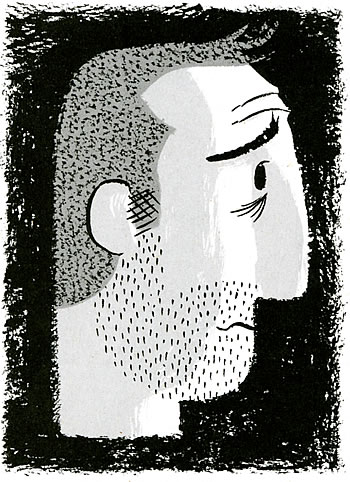
Andi Watson: “Life and drawing are tied together. Without art I don’t know who I would be.”
INTERVIEW WITH andı watson
An expansive conversation on comics, life, and ambiguity.
Andi Watson, in Focus 👈🏻
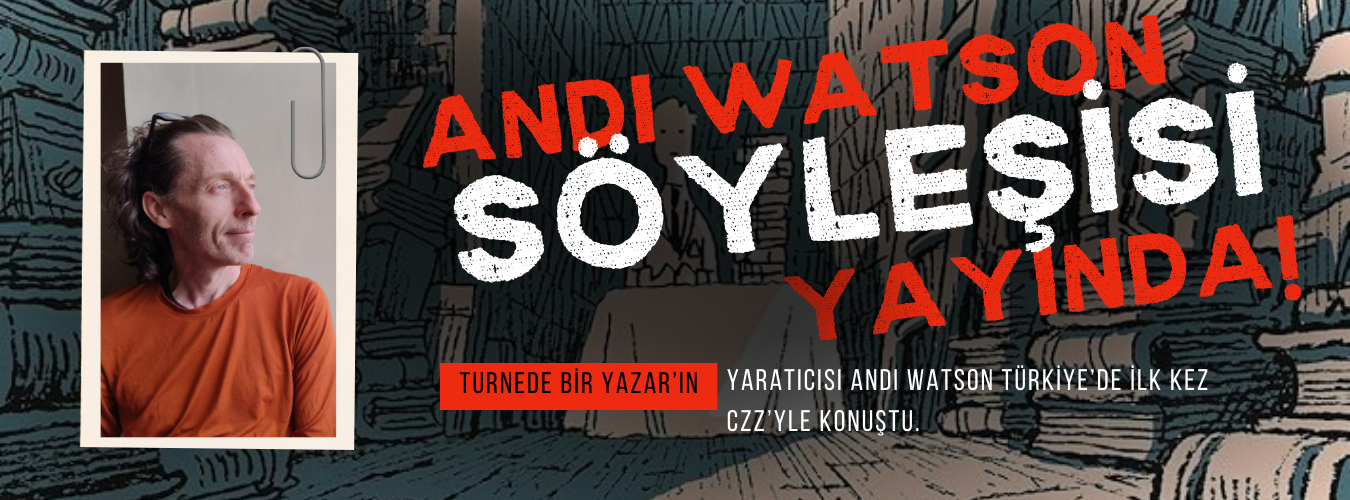
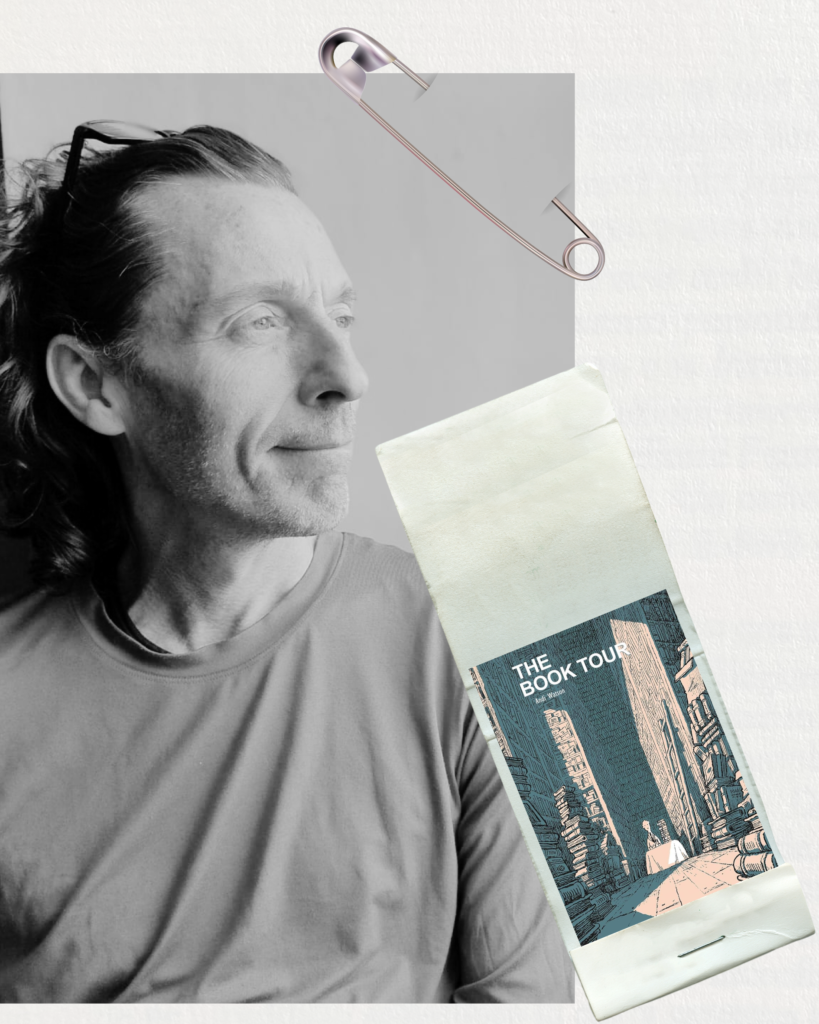
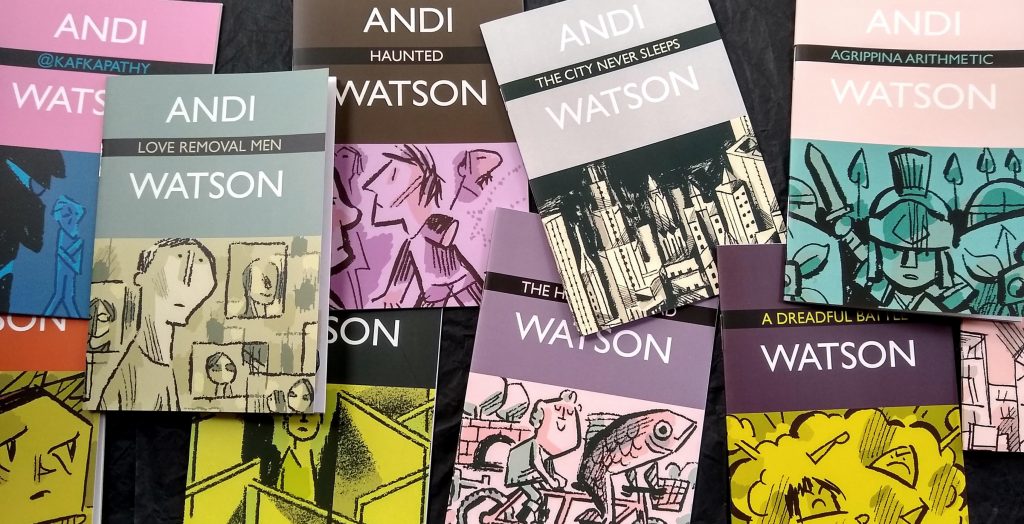
Andi Watson is a British cartoonist, writer and illustrator who has been nominated for four Eisners, two Harveys and an official selection of the Angoulême International Festival. He has written and drawn graphic novels in a wide variety of genres and for different age groups for publishers as diverse as Random House, Walker books, First Second, Harper Collins, DC, Marvel, Dark Horse, Image and Top Shelf. His work has been translated into French, Spanish, Italian, Polish, German, Portuguese, and Turkish. He lives in Worcester with his wife and daughter.
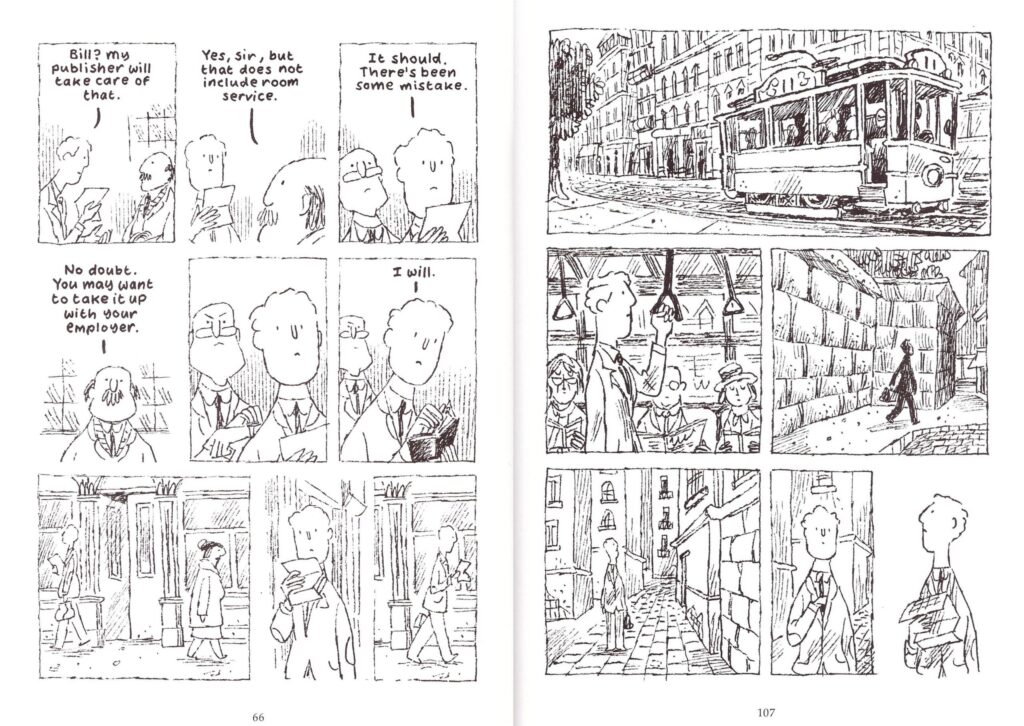
In this interview, we speak with Andi Watson about comics not only as a narrative form, but as a way of organizing and making sense of life. Through works such as Skeleton Key, Breakfast After Noon, and The Book Tour, Watson reflects on quietness, emotional distance, slowness, and ambiguity as deliberate creative choices. Our conversation traces a long creative journey—from DIY culture and independent production to the material realities of making comics, and from there to how small decisions, restraint, and uncertainty shape both storytelling and lived experience.
When you look back from your earliest works to today, has comics been more of a way of telling stories for you, or a way of organizing life itself? How has the balance between these two changed over time?
Excellent question. It is difficult to untangle. When I first started making comics I had to teach myself about stories. I hadn’t done much writing before, but I saw that learning to write was key to making comics. That words and images in combination are the unique strength of the medium. Also, if I wanted to make comics, rather than wait for permission from a publisher or the industry, I would need to write my own. I was inspired by skateboarding and hardcore music, the DIY ethos and zines. Make a thing and assemble it yourself. Go to the photocopy shop (as it was then) and buy a long arm stapler. There is a kind of naive romance and freedom to that. You can do anything you want and you don’t need a stack of money or resources. You can just do it.
So I learned how to put scenes together, dialogue, dramatic structure, character arcs. I studied film, novels, and comics. It took me a while because I was starting from scratch. But why learn to tell stories or make zines or spend many hours drawing imaginary people in boxes with balloons over their heads with invented words inside? It is a strange thing to do. Part of the reason for me is to better understand life. To try and make sense of the chaos of existence. When I am creating I am more aware, more open, more alive then when I am not. Life and drawing are tied together. Without art I don’t know who I would be. Between projects I feel adrift. I think I have a brain that needs to be wrestling with some sort of problem or other and trying to resolve it. That I create and resolve these problems gives me a sense of satisfaction, but also a fair amount of angst.
So art does many things for me. It gives me a direction for my thoughts and energies. Without it I would be obsessing over something pointless. This way I am focused. I am thinking, observing, listening. Telling stories doesn’t lead to any great epiphanies about life. You are not necessarily wiser for it. In fact, thinking in terms of three act structure and Hollywood endings is probably bad for you.
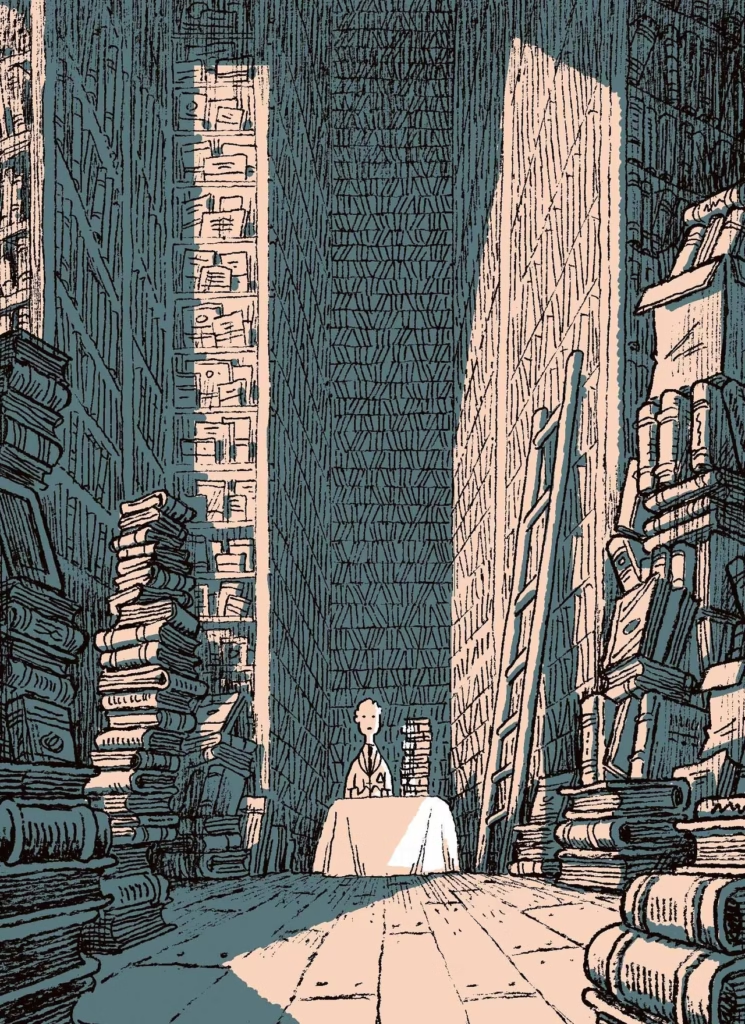
Comics probably do appeal to those who like to create order out of chaos. There is the inbuilt structure and grammar. A series of thoughts and actions within boxes in a sequence. So any book gives the illusion of imposing order on the randomness of life, even as it embraces the randomness of life as in The Book Tour.
Your work often focuses on “small” moments, everyday relationships, and quiet ruptures. Was choosing this space over grand dramatic narratives a conscious political decision, or simply the place you naturally arrived at?
It is probably partly a reaction against the melodrama of American superhero comics and partly the talents I have as a cartoonist. I am not well suited to action, dramatic angles and exaggerated emotion. I admit I have always felt a little queasy about the violence in superhero comics and the underlying idea that might is right and the political subtext of that. I lean towards understatement in my own work, visually and thematically.
It’s also how I see life. Not in wide-screen gestures and statements, but in small moments. I have led a quiet life. I don’t enjoy drama and upheaval. It is the small moments that make a life. The quiet revelations and insights. Internal realisations. The decision to marry or have a child is quite small on the face of it. They are the moments that have a profound impact on the direction your life takes. Despite the cliché that ‘comics have no budget’ (which also happens to be untrue) I think it is adept at addressing quiet moments. The way still images in sequence simultaneously travel in time and are frozen in time is particularly powerful. It can be in a nine panel grid or a splash page. A series of small moments or one big one.
When I was still a teenager I got back into comics. I was a reader. I never felt I would make my own. It seemed impossible. Too difficult. Too much to take on. Then I found a copy of a UK reprint of Love and Rockets. It completely blew my mind. You can make comics about people who fall in love and argue and go to gigs? Comics could be about emotions and music and not just about magic swords and punching each other in the face? I went on to study illustration and graphic design for my degree, but the seed was sown spending my birthday money on a trip to the comic shop one day. My final degree show was a comicbook. I figured I’d never get the chance to make another. It altered the course of my life.
You have moved between independent comics production in the UK and the US-centered publishing system. How did these two cultures affect your language of production and narrative rhythm? Did you ever feel freer in one and more disciplined in the other?
My experience of working with one of the big five US publishers is acknowledging you are entering a large bureaucracy. It has systems in place that exist to ease its work flow. Understandable as any editor is juggling multiple books in various stages of production. You adapt to their systems, breaking down each element separately: script, thumbnails, lettering, pencils, inks, colours. That way of working hasn’t resulted in my best work. I prefer a more organic approach. Allow space for a story to take a different direction. Finish drawing a book and then go back to refine and edit the story. This isn’t possible when resources (mostly time of the editor) are limited. Completing one element and then going back to the work already completed becomes a headache.
It is usually less restrictive at independants, the flip side of that is there are fewer resources and, on a purely practical level, the money is much less. My preference is to complete a book and take it to a publisher rather than develop it with an editor. The larger publishers generally prefer greater editorial input and my best work has succeeded creatively outside of that.
Distance, Autobiography, and Transformation
There is a noticeable emotional distance between works like Skeleton Key, Breakfast After Noon, and your later projects. Has the distance you place between your own life and your work increased over the years, or has only the form of expression changed?
I’ve been drawing one page comics for my Patreon for the last five years. These are in the slice-of-life tradition. Literally about my life. That is about the closest I have come to autobiography and it is fairly recent. I am not from the Joe Matt school, though. I have boundaries.
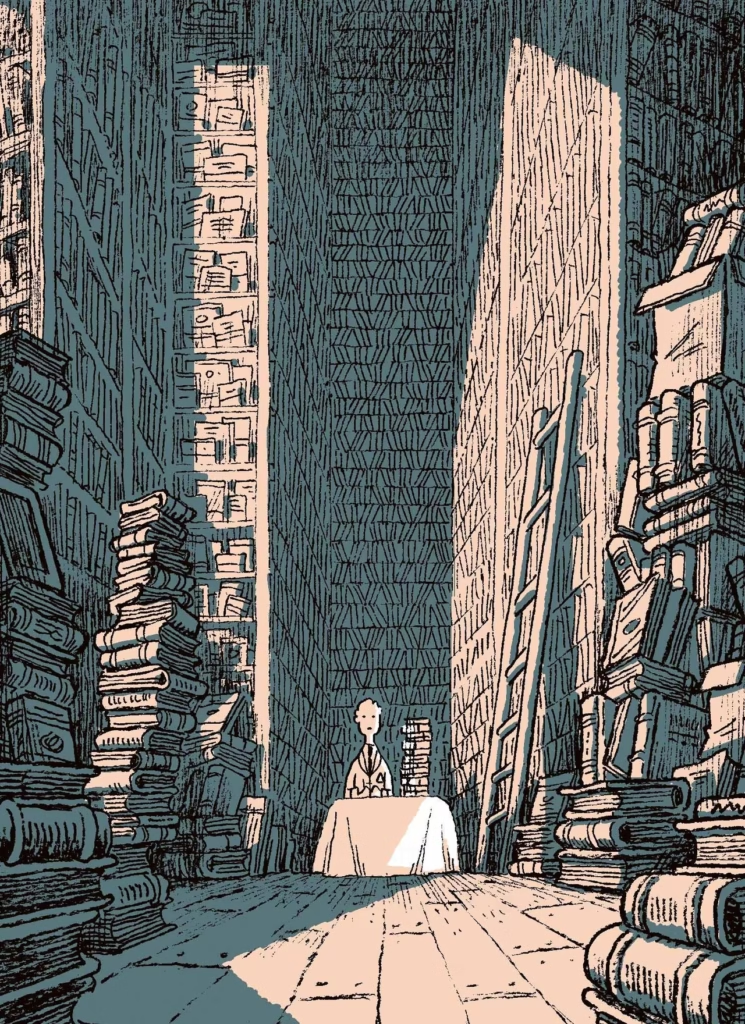
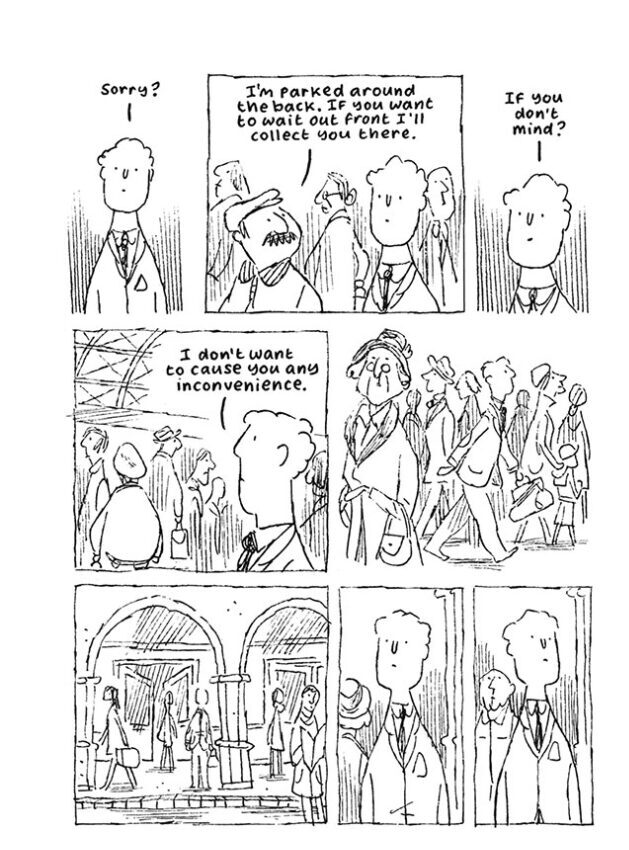
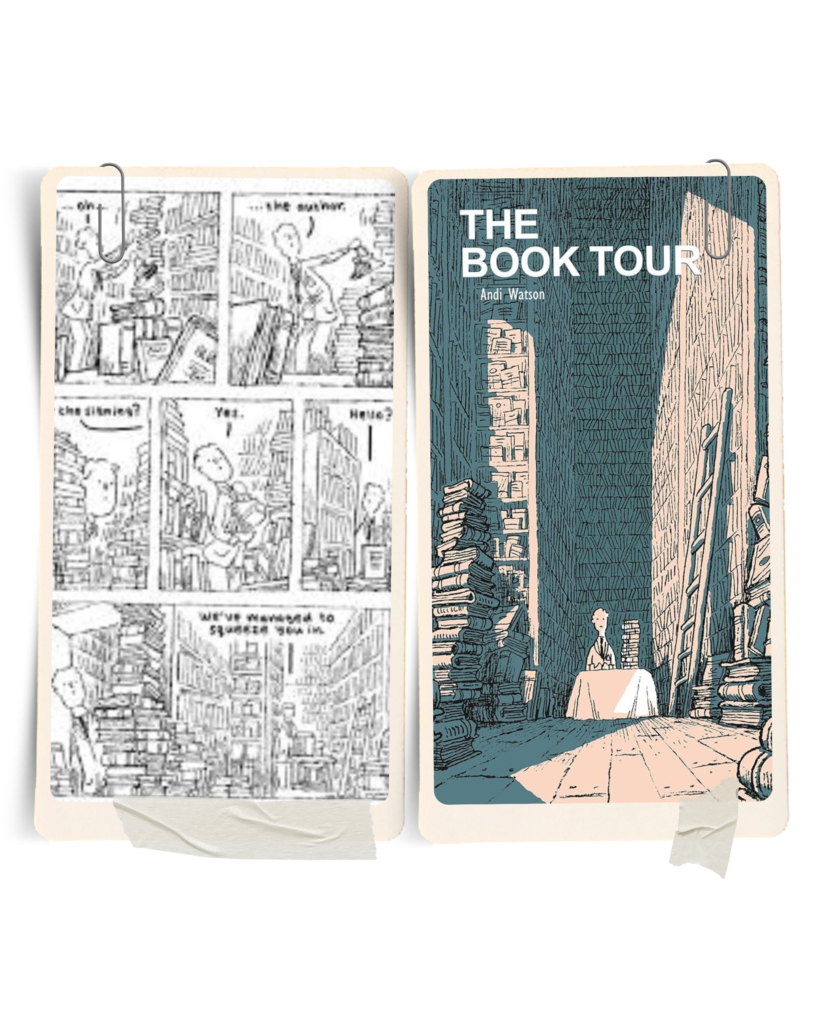
I think the most successful synthesis has been with the Book Tour. I took a bunch of anxieties from my own life and transformed them into fiction that succeeded dramatically and thematically in comic form.
I don’t know what’s next. I have had projects lined up since Covid. Now I am looking at a blank page. I would like to react spontaneously. See what comes out of the sketchbooks. See what words I write. I don’t know what my subconscious is up to. I don’t know what emotional shape it will take. That is what keeps me interested in creating comics. If I had to draw Batman everyday for the rest of my life I would quit and find something else to do.
Your drawings are often minimal, even fragile, yet when combined with text they create a strong emotional intensity. How do you recognize the moment when you are deliberately avoiding “over-explaining” a scene?
That is a really interesting question. Hopefully I am harnessing the language of the medium by saying just enough with words and pictures to convey the emotion without clumsily whacking the reader over the head and have big neon signs reading: this is where you feel sad now. The scene itself is not necessarily freighted with emotion, but in the context of the scenes and interactions of the characters leading up to and resulting from that moment. It is a tricky balancing act of where to place a certain moment, what comes before and after.
Also, honestly, it is probably because I am much more confident as an artist than as a writer. Even as the years have gone on and I have become more interested in writing, I feel like I am still on solid ground with my art. So if I felt I was better with words, I might fall into ‘over-explaining’. Perhaps not. I am happiest writing dialogue and dialogue is best when it is ambiguous. If a character is saying exactly what is on their mind it isn’t interesting. I am more willing to edit, to cut words, panels and pages. I try and let the words and pictures each do their thing, not step on each others toes. That is the weird magic of the medium, together they are greater than the sum of their parts. That is reflected in my own abilities. I am neither a particularly gifted draughtsperson or writer, but in the liminal space of comics I can create something interesting.
I do lean more towards ambiguity as I have got older. I have also become interested in weird fiction, a hard to define area of writing that spans Lovecraft to Kafka. I am fascinated by a genre that isn’t quite a genre. Something that is key to the ‘weird’ is that elements are unexplained or unexplainable. I don’t make ‘weird’ work, but I do appreciate the ambiguity and unknowability within a work. I want to leave space for the reader. Not everything has to be known or explained. I want there to be some uncertainty. I want my intelligence as a reader to be respected, and I want to accord my readers the same respect.
“Any book worth its salt has to come from a need to tell it, regardless of format or age group or any aspect of industry marketing that is separate from the work itself.”
There seems to be an invisible connection between the works you produced for children and young readers and those aimed at adults. Do you think a good story ultimately operates from the same place, regardless of age group?
Absolutely. Books have had a profound influence throughout my life. As a kid I read The Phantom Tollbooth, The Sword in the Stone, Where the Wild Things Are, The Machine Gunners, When Hitler Stole Pink Rabbit, all of which still stand up for me as an adult reader. And there are childrens books I read as an adult that delighted and disturbed me, The Mouse and His Child and the Uncle books. Any book worth its salt has to come from a need to tell it, regardless of format or age group or any aspect of industry marketing that is separate from the work itself. There may be more obstacles in making work for children that stem from editorial and industry conventions. They can come from unexpected places too. In one of my middle grade books there was an extended back and forth on the morality of stealing that came from differences in American and English sensibilities. I don’t think Robin Hood could be a hero there. Especially not at the moment.
As an artist with a long creative career, I’d like to ask this: When you look back today, are there works you think “I wouldn’t tell this this way anymore,” or do you see each work as a record of its own time?
I have a bit of a phobia about reading old work. I am worried it will be awful and cringe and I’d rather look ahead to what is next than worry about the past. Self confidence is quite fragile in creative work. Why have a crisis of confidence over a book that’s been out of print for years? Some of it is also self preservation when putting work out into the public. Someone will be casually cruel about it. Someone will say it is the worst thing they have ever read or seen. Someone will also say it is the best thing ever, but I never remember that. I try to think of it as something I have been nurturing by myself in my little studio space. When the time comes to publish it I have to separate it from myself. The work is not me, and I am not it (even if I am). It exists in its own space. So I guess I fall on it being a record of its time. But perhaps I am deluding myself, avoiding taking responsibility for work that I now find embarrassing. For all these reasons I don’t read my old work. I would much rather read someone else’s.
“I think there will be a reaction against AI and the overwhelming tidal wave of slop.”
Today, comics production moves under pressure from speed, visibility, and social media. Do you believe that slow narratives still have a strong resonance in this era?
Comics is always a balance between creation and production. It’s a labour intensive medium. There’s no getting away from the fact that a graphic novel is a lot of work. It is slow work, it is painstaking work, especially in the context of modern media. I recently spent more than a week going over the lettering of a graphic novel, not correcting typos but realigning individual letters and redoing hundreds of e’s. It is a throwback to monks and illuminated manuscripts. A form of obsessive devotion to making a thing by hand. Having said that, I did despair at points and fall back on using a font for some panels because I could feel hours of my life slipping away. I was seriously asking myself, is this how I want to live? No one else will care or notice. Why am I like this?
I think there will be a reaction against AI and the overwhelming tidal wave of slop. There will be interest in authenticity and with the physical object. Concrete evidence of the human hand at work. I don’t know if that will be enough to sustain artists economically, but humans have always made art and always will. If humans are interested in engaging in and supporting art created by other humans remains to be seen. I know that the words ‘fan created Disney content’ hold absolutely zero interest to me as a person and artist. I am not alone. In an AI creative wasteland, perhaps me and few others will sit around swapping one sheet zines between begging for food.
“You will have bad days, bad weeks, bad years maybe, it’s to be expected. You are human.”
The relationship you build with readers is often quiet but deep. Are there moments in your work where you hope the reader feels something very specific, or do you leave the meaning entirely to the reader?
I am sentimental by nature. I cry easily. Sick animals, children leaving home, my buttons are easy to push and the required emotional response will be produced. Bing Bong from Inside Out? I am crying ugly in the cinema. So I am suspicious of seeking to manipulate the reader. I feel that it is dishonest for some reason. It is more if my own reaction to the charcters and situations is genuine then that will be communicated to the reader. With something like The Book Tour I feel like I am outside observing these uncomfortable interactions, a little distant but also zooming in and experiencing the embarrassments and casual cruelty. I am both inside and outside the story. That felt like the appropriate point of view for that book.
Finally, for someone who is just starting to produce comics today: What would be the most important piece of advice you would give on a mental or conceptual level, rather than a technical one?
Going back to small decisions having a great impact on your life, I think any freelance career in the arts is precarious. The majority of people do not make a living from their art. Ten percent, probably fewer than that. I think it is worth considering what that means in practical terms where money means shelter and food. It can mean you won’t ever be able to buy your own home, to start a family, to experience financial stability. This might sound awfully bourgeois, but if those things are important to you, and they might not be important to you now, but they might be later, then it is worth keeping in mind. I am lucky enough to live in a country with free healthcare so I am not risking my life drawing funny books.
Otherwise, remember you are not an art-making machine. We now have machines that claim to do that and the art they make is garbage. You will have bad days, bad weeks, bad years maybe, it’s to be expected. You are human.